
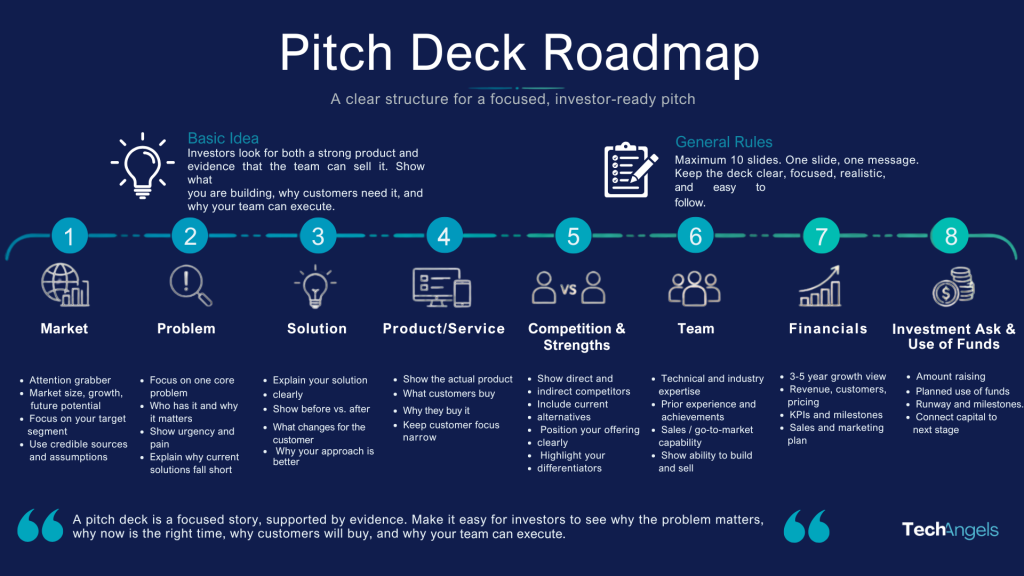
Basic Idea
Investors typically look for two things at the same time: a strong product or service and evidence that the team has the skills to sell it.
In the pitch deck, show what you are building, why customers need it, and why your team can turn it into a scalable business.
Provide figures where possible, explain your assumptions, and show that you understand your customers, your market, and your route to sales.
Confidence helps. It is good to show ambition and strengths, as long as the deck remains clear, realistic, and supported by evidence.
General Rules
Presentation
Maximum 10 slides.
A pitch deck should be focused and easy to follow. It is not meant to explain everything; it is meant to help investors quickly understand the opportunity and decide whether they want to continue the conversation.
One slide, one message.
A presentation is like a hammer: hit one nail at a time. Each slide should have one clear point.
Avoid crowded slides, too many messages, and unnecessary detail.
Structure
1. Market
Use the market slide as an attention grabber. This is an important slide because it helps investors understand why the opportunity is attractive and why now is the right time.
Show:
- The target market you are addressing
- Market size and growth
- Future potential, not only past figures
- The specific segment you will focus on first
- Credible sources or clear assumptions behind your numbers
When using projections, make them realistic and explain the logic behind them. Investors do not expect perfect predictions, but they do expect numbers that are credible.
Avoid generic market figures. Investors need to understand where your company fits inside the market, not just that the market is large.
2. Problem
Use one slide to explain the main problem.
Focus on one core problem rather than listing too many issues.
Explain:
- Who has this problem
- Why it matters
- How painful, costly, frequent, or urgent it is
- Why existing solutions are not enough
A clear and specific problem is easier to understand and more convincing than a broad or generic one.
3. Solution
Explain your solution clearly.
Show the difference between the current situation and the improved situation created by your product or service.
Include:
- What your solution does
- Who it helps
- What changes for the customer
- Why your approach is better, faster, cheaper, easier, or more effective
Make the value easy to understand. Investors should quickly see why customers would care.
4. Product / Service
Be explicit and make the product or service easy to grasp.
Show the actual product or service where possible, using screenshots, workflows, demo images, examples, or a simple explanation of how it works.
Explain:
- What the customer buys
- Why they buy it
- How they use it
- What value they receive
If you include customer segments, keep the focus narrow. One slide is usually enough. Use two only if it is truly necessary.
Make a clear choice about your priority customer segment. Too many customer types can make the deck look unfocused.
For each priority customer segment, identify one key point:
- What do they buy?
- Why do they buy?
Be specific. Investors should quickly understand what you are selling and to whom.
5. Competition and Competitive Strengths
Show that you understand the competitive landscape.
Include:
- Direct competitors
- Indirect competitors
- Existing alternatives
- How customers solve the problem today
- Your competitive advantages
A simple positioning graph can help investors quickly understand the differences between you and other options in the market.
Explain your competitive strengths clearly. These may include:
- Better product
- Better technology
- Better distribution
- Lower cost
- Faster implementation
- Stronger customer insight
- Proprietary data
- Partnerships
- Relevant expertise
Avoid saying you have no competition. If the problem exists, customers are already solving it somehow.
6. Team
Show why this team can build and sell the business.
Include:
- Relevant technical expertise
- Technical degrees or credentials, where relevant
- Industry knowledge
- Previous startup or business experience
- Prior achievements
- Sales, marketing, or business development capability
Investors want to see both product-building ability and commercial execution.
If the team lacks sales or go-to-market experience, mention advisors, partners, board members, or planned hires who can help fill that gap.
The key question is: does this team have, or can it attract, the skills needed to build the product and sell it?
7. Financials
Show how the business can grow over the next 3–5 years.
Include:
- Expected turnover / revenue over the next 5 years
- Business objectives
- Expected number of customers
- Pricing model
- Main cost categories
- Key milestones
- Important assumptions behind the numbers
Investors do not expect perfect predictions, but they do expect clear logic.
Business Objectives
Explain what you want to achieve in business terms.
For example:
- How many customers you aim to reach
- Which markets or segments you will enter
- What revenue milestones you expect
- What operational milestones matter for the next stage
KPIs
Include the KPIs that are most relevant for your business model.
Examples:
- Customer acquisition cost
- Revenue per customer per year
- Customer retention
- Sales pipeline
- Conversion rate
- Usage or engagement
- Gross margin, where relevant
- Sales cycle, where relevant
Sales and Marketing Plan
Show how you intend to reach customers and generate revenue.
Include:
- Sales channels
- Marketing channels
- Partnerships
- Direct sales strategy, if relevant
- Expected sales cycle
- Main growth assumptions
The financial plan should connect clearly to your market, pricing, product, and go-to-market strategy.
8. Investment sought and use of funds
State clearly how much investment you are raising and what you will use it for.
Include:
- Amount raised
- Planned use of funds
- Runway
- Key milestones this funding will help you reach
- Main hiring or spending priorities
- Future funding needs, if relevant
Break down the use of funds into concrete categories, such as:
- Salaries and key hires
- Sales and business development
- Marketing
- Product development
- Technology infrastructure
- Servers or cloud costs
- Legal, compliance, or operational needs
- Market expansion
Make the connection between the investment and the next stage of growth very clear.
You should ask for an amount that realistically supports the milestones you need to reach. Do not under-ask if the business requires more capital to achieve meaningful progress, but make sure the amount is justified by a clear plan.
Final Reminder
A pitch deck is not a full business plan. It is a focused story, supported by evidence.
Make it easy for investors to understand:
- Why this problem matters
- Why now is the right time
- Why your solution is credible
- Why customers will buy
- Why your team can execute
- Why the investment opportunity is attractive
Before sending the deck, check that each slide has one clear message and that the overall story is simple, credible, and convincing.